Autonomous Response in cybersecurity: learn how SentinelSuite, thanks to SentinelCore, FireDog, CyberSheppard, IntelliDog and the Model Context Protocol (MCP), automates the detection, mitigation and vulnerability verification cycle.
Index
- What is Autonomous Response
- Why the Model Context Protocol changes the paradigm
- From Vulnerability Management to automatic mitigation
- SentinelSuite: an ecosystem orchestrated by AI Agent
- A real example of Autonomous Response
- The advantages of an agent approach
- Conclusions
What is Autonomous Response
Autonomous Response represents one of the most interesting developments in modern cybersecurity. If in recent years Artificial Intelligence has been used primarily to analyze data, classify vulnerabilities or assist analysts through chatbots, today we are entering a new phase: that in which AI Agents can understand the context, make decisions and orchestrate different tools in a controlled and traceable way.
This evolution is made possible by Model Context Protocol (MCP), a standard that allows agents to communicate with external applications, services and tools always keeping the operating context.
It is precisely this direction that I am following in the development of SentinelSuite, the ecosystem composed of SentinelCore, FireDog, CyberSheppard and the AI module IntelliDog.
The goal is not to replace security analysts, but to provide them with a platform that drastically reduces the time between identifying a risk and applying a countermeasuring.
Autonomous Response: why the Model Context Protocol changes the paradigm
Traditionally, safety instruments operate as independent silos.
A scanner detects a vulnerability.
A SIEM generates an alarm.
A firewall blocks an IP address.
A hardening system checks compliance.
The analyst must collect all this information, interpret it and decide manually what action to take.
With theAutonomous Response, instead, this paradigm changes completely.
Through an MCP server, an AI Agent can simultaneously question all the tools of the platform, understand the context and use their respective features in a coordinated manner.
It is therefore not limited to reading data.
It can also perform operations, verify the result and adapt the mitigation strategy according to the evolution of the accident.
Autonomous Response and Vulnerability Management
Let's imagine a real scenario.
SentinelCore receives results from OpenVAS, Nmap or other security scanners.
Vulnerabilities are related, deduplicated and retrievable considering numerous factors:
- CVSS score – EPSS – KEV;
- Internet exposure;
- public exploit availability;
- criticality of the asset;
- possibility of lateral movement;
- identified attack paths;
- overall infrastructure risk.
At this point the AI Agent comes into play.
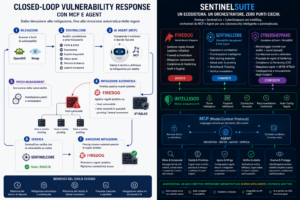
Thanks to the MCP, the agent can understand the vulnerability context and decide that, pending the application of the patch, it is necessary to immediately reduce the attack surface.
The agent then calls FireDog.
FireDog automatically applies a rule iptables or nftables on the vulnerable host.
But the process is not limited to the machine concerned.
If SentinelCore identifies possible pivoting or lateral movement paths, FireDog may temporarily apply containment rules on the hosts involved, limiting the propagation of a possible attack.
We're not replacing remediation.
We are introducing an intelligent and temporary mitigation capable of lowering the risk to the distribution of final correction.
SentinelSuite: an ecosystem of Autonomous Response
La vera forza della piattaforma emerge quando tutti i moduli collaborano tra loro.
SentinelCore
SentinelCore rappresenta il motore di Vulnerability Management.
Correla i risultati provenienti da scanner differenti, assegna una priorità alle vulnerabilità, individua possibili percorsi di attacco e verifica l’efficacia delle remediation.
FireDog
FireDog è il motore operativo della suite.
Gestisce firewall Linux tramite iptables and nftables, applica mitigazioni temporanee, implementa regole di hardening e può essere controllato direttamente dagli AI Agent attraverso MCP.
CyberSheppard
CyberSheppard non è un semplice inventario degli asset.
È un correlatore di eventi e un MicroSIEM orientato ai sistemi Linux.
Attraverso auditd and Laurel monitora continuamente le chiamate di sistema (syscall), raccoglie eventi di sicurezza e li arricchisce con informazioni contestuali.
Le regole sono mappate sul framework MITRE ATT& CK, consentendo di classificare gli incidenti secondo tattiche e tecniche riconosciute a livello internazionale.
CyberSheppard è inoltre in grado di:
- proporre regole di hardening;
- verificare il livello di compliance rispetto ai benchmark CIS;
- monitorare continuamente lo stato degli asset;
- individuare comportamenti anomali;
- fornire evidenze utili durante le attività di incident response.
IntelliDog
IntelliDog rappresenta il livello di intelligenza della piattaforma.
Utilizzando gli AI Agent e il Model Context Protocol può:
- interrogare contemporaneamente tutti i moduli della suite;
- correlare eventi, vulnerabilità e configurazioni;
- proporre playbook dinamici;
- suggerire le migliori strategie di mitigazione;
- adattare automaticamente le decisioni in base al contesto operativo.
A real example of Autonomous Response
Immaginiamo un server Linux esposto su Internet.
Una scansione individua una vulnerabilità critica con exploit pubblico disponibile.
SentinelCore la classifica come priorità massima.
CyberSheppard verifica che il sistema presenta anche alcune configurazioni non conformi ai benchmark CIS e rileva attività sospette attraverso le regole di auditd arricchite da Laurel.
L’AI Agent raccoglie tutte queste informazioni tramite MCP.
Comprende che il rischio è elevato e decide di applicare immediatamente una mitigazione.
FireDog distribuisce automaticamente una regola firewall che limita l’esposizione del servizio vulnerabile.
Se vengono individuati host coinvolti in possibili percorsi di lateral movement, la mitigazione viene estesa anche a questi sistemi.
Nel frattempo il team IT distribuisce la patch.
Alla successiva scansione SentinelCore verifica che la vulnerabilità è stata risolta.
L’agente riceve il nuovo contesto.
FireDog rimuove automaticamente le regole temporanee ripristinando la normale operatività.
L’intero processo è stato eseguito in maniera tracciabile, contestuale e coordinata.
Questo è il significato concreto di Autonomous Response.
I vantaggi dell’Autonomous Response
L’adozione di un modello di Autonomous Response offre numerosi benefici:
- riduzione del Mean Time To Respond (MTTR);
- mitigazione immediata delle vulnerabilità critiche;
- riduzione del rischio di movimento laterale;
- maggiore coerenza nelle attività di risposta;
- automazione delle operazioni ripetitive;
- miglior supporto agli analisti SOC;
- completa tracciabilità delle azioni eseguite;
- integrazione naturale con infrastrutture Linux.
Il valore non risiede nell’automazione fine a sé stessa.
Il vero vantaggio consiste nell’orchestrare strumenti differenti mantenendo sempre il controllo umano sulle decisioni strategiche.
Conclusions
L’Autonomous Response rappresenta una naturale evoluzione della cybersecurity.
Non sostituisce gli esperti, ma mette a loro disposizione strumenti capaci di collaborare, condividere il contesto e reagire rapidamente agli eventi.
Con l’integrazione del Model Context Protocol, SentinelSuite evolve da una semplice raccolta di applicazioni a un ecosistema completamente orchestrato.
SentinelCore identifica e prioritizza il rischio.
CyberSheppard osserva il comportamento dei sistemi, verifica la compliance e correla gli eventi.
FireDog applica le mitigazioni operative.
IntelliDog coordina gli AI Agent, interpreta il contesto e orchestra l’intero processo.
Il risultato è una piattaforma capace di accompagnare l’intero ciclo di vita della sicurezza: dalla scoperta delle vulnerabilità, alla correlazione degli eventi, dalla mitigazione automatica fino alla verifica della remediation.
Per molti l’Intelligenza Artificiale è ancora sinonimo di chatbot.
Per me rappresenta qualcosa di molto più ambizioso: un ecosistema di Autonomous Response in cui gli strumenti collaborano tra loro, condividono il contesto operativo e trasformano la cybersecurity da reattiva a realmente adattiva.
It might also interest you
- SentinelCore v1.2.0: the First Step Towards a Cybersecurity that acts from Sola
- Continuous Monitoring: why do Vulnerability Management not only mean performing scans. How to use Openvas + SentineCore for your CM
- Expect and Preven with Threat Intelligence: How Dognet Technologies Protects You From Future Attacks

