We have always considered Threat Intelligence a fundamental element of security.
But there is a question that, according to us, is placed too little:
"What does this threat really mean for my infrastructure? "
Knowing that there is a new C, that an IP is associated with a malicious activity or that a new campaign has been observed is not enough.
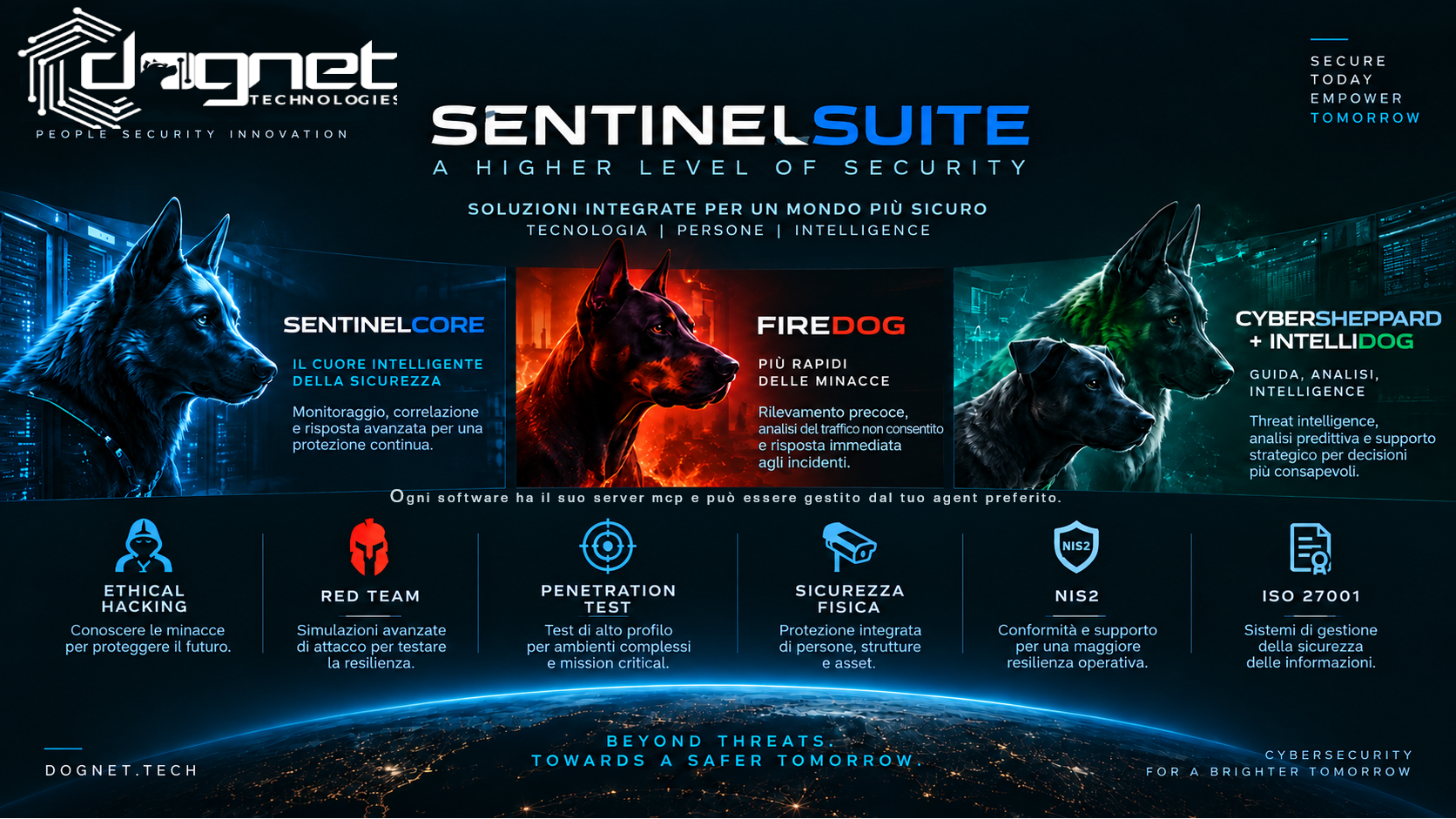
The real value comes when this information can be related to what is happening inside the systems that we must protect. For this reason it is born IntelliDog, the fourth component of SentinelSuite and expansion module CyberSheppard dedicated to Threat Intelligence and Threat Hunting.
From threat intelligence to context
We imagine we have a critical vulnerability on a system. A vulnerability scanner can report it. SentinelCore can analyze it, correlate it with the infrastructure context and establish its priority.
But IntelliDog adds a fundamental question:
Are there any evidence that someone is trying to exploit it?
It can correlate threat intelligence, IoC, observed activities, vulnerabilities and telemetry of systems to build a more complete picture of exposure.
And this opens much more interesting scenarios.
A new CVE is published
We do not just know that our software is potentially vulnerable.
We can look for indicators associated with the threat, check the presence of suspicious activity in the available data and make threat hunting even retroactive.
The question becomes:
"Is this threat only a vulnerability present in our systems or are there already evidence of hostile activity? "
An IoC is classified as malevolent
An IP, a domain, a hash or another indicator can become relevant after an event has already happened.
With the retroactive IoC hunting we can ask ourselves:
"Is this indicator already in our systems? "
Not only today. Even weeks before. Or a month before Why an event that yesterday seemed irrelevant can assume a completely different meaning when associated with a new intelligence information.
And when can't we patch immediately?
It is one of the most concrete scenarios in real security. A legacy system. An application that cannot be stopped. A patch that requires testing. A component that cannot be updated immediately.
In these cases the goal is not to pretend that the problem is solved.
IS reduce the display window while the definitive remediation is prepared.
The Threat Intelligence can help identify the attack vector and, through integration with the other components of the suite, get to mitigation.
But here comes another element of our architecture.
Each component of the SentinelSuite has its own MCP Server.
IntelliDog uses the CyberSheppard MMCP Server.
And we deliberately chose to go beyond the simple concept of "tool that exposes some APIs". We are increasing the capabilities of MCP-connected agents so that they can use much wider operational capabilities than those available in the normal software interface.
For example, CyberSheppard can use capabilities auditd to build specific auditing rules, or generate configurations AppArmor and ModSecurity. FireDog can operate on the network, until reading and creating route necessary for monitoring and containment activities.
SentinelCore can arrive at testing and preproduction operations: for example, use a clone of a VM in the test environment to verify the introduction of a new AppArmor or ModSecurity configuration before applying it to the real system.
Questo è il punto che per noi è fondamentale.
L’AI non deve limitarsi a spiegare cosa sta succedendo.
Deve poter utilizzare strumenti e capabilities reali per analizzare, verificare, testare e contribuire alla mitigazione. Naturalmente, con le necessarie autorizzazioni e all’interno dei perimetri definiti.
È questa la direzione di SentinelSuite
Non abbiamo costruito semplicemente quattro software indipendenti. Abbiamo costruito componenti specializzati che possono collaborare:
SentinelCore Vulnerability management, prioritizzazione e orchestration.
FireDog Network monitoring, analisi del traffico e response.
CyberSheppard Host monitoring, auditing e hardening.
IntelliDog Threat Intelligence e Threat Hunting.
E gli MCP Server permettono agli agenti di trasformare queste capabilities in azioni coordinate.
Il risultato che cerchiamo è un passaggio molto concreto:
Detection → Context → Decision → Test → Mitigation
non semplicemente:
Alert → Dashboard → Ticket.
E il software non è l’unica cosa che facciamo.
SentinelSuite nasce dalla nostra esperienza sul campo.
Per questo, oltre allo sviluppo dei nostri software, continuiamo a fornire servizi avanzati di cybersecurity ed ethical hacking, tra cui penetration test, Red Team, Black Ops e Tiger Team, comprese attività di physical penetration testing come già vi avevamo accennato.
Prepariamo anche vm/contenitori con ottime baseline di sicurezza e progettiamo reti microsegmentate con vlan security, monitorate in hyperconvergenza proxmox, scalabili e adattabili a rapide crescite come nelle moderne startup.
Vi aiutiamo inoltre a stendere policy per una governance che rispetti standard e framework, e molto altro ancora (brochure e dettagli sul nostro sito ufficiale).
Il software nasce anche da ciò che impariamo lavorando sulle infrastrutture reali. E quello che sviluppiamo lo utilizziamo direttamente nelle nostre attività. Per noi è una differenza importante:
non sviluppiamo strumenti per osservare la cybersecurity da fuori. Li sviluppiamo perché la cybersecurity è il nostro lavoro.
IntelliDog è il prossimo passo di questa evoluzione. Threat Intelligence non come un feed da consultare. Threat Intelligence come conoscenza operativa dell’ambiente che stiamo proteggendo.
We're not just selling cybersecurity. We do.
#Cybersecurity #ThreatIntelligence #ThreatHunting #AI #MCP #CISO #VulnerabilityManagement #RedTeam #EthicalHacking #SentinelSuite #DognetTechnologies

