
ITA
What if your security tools don't just share data, but actively collaborate to detect, monitor and mitigate threats?
In the world of cybersecurity, talking about integration often means connecting APIs, aggregating logs or correlate results from different products.
All useful, of course. But integration can do much more.
With SentinelSuite, Dognet Technologies develops an architecture in which individual tools are not limited to exposing information: they share relevant data, identify opportunities for intervention and propose concrete actions within their competences.
Not simple correlation of data, therefore, but operational collaboration between security instruments.
[Chuckles] Two levels of integration: Responder and Action
We designed our integration model on two levels, distinguished by complexity, operational capabilities and execution requirements.
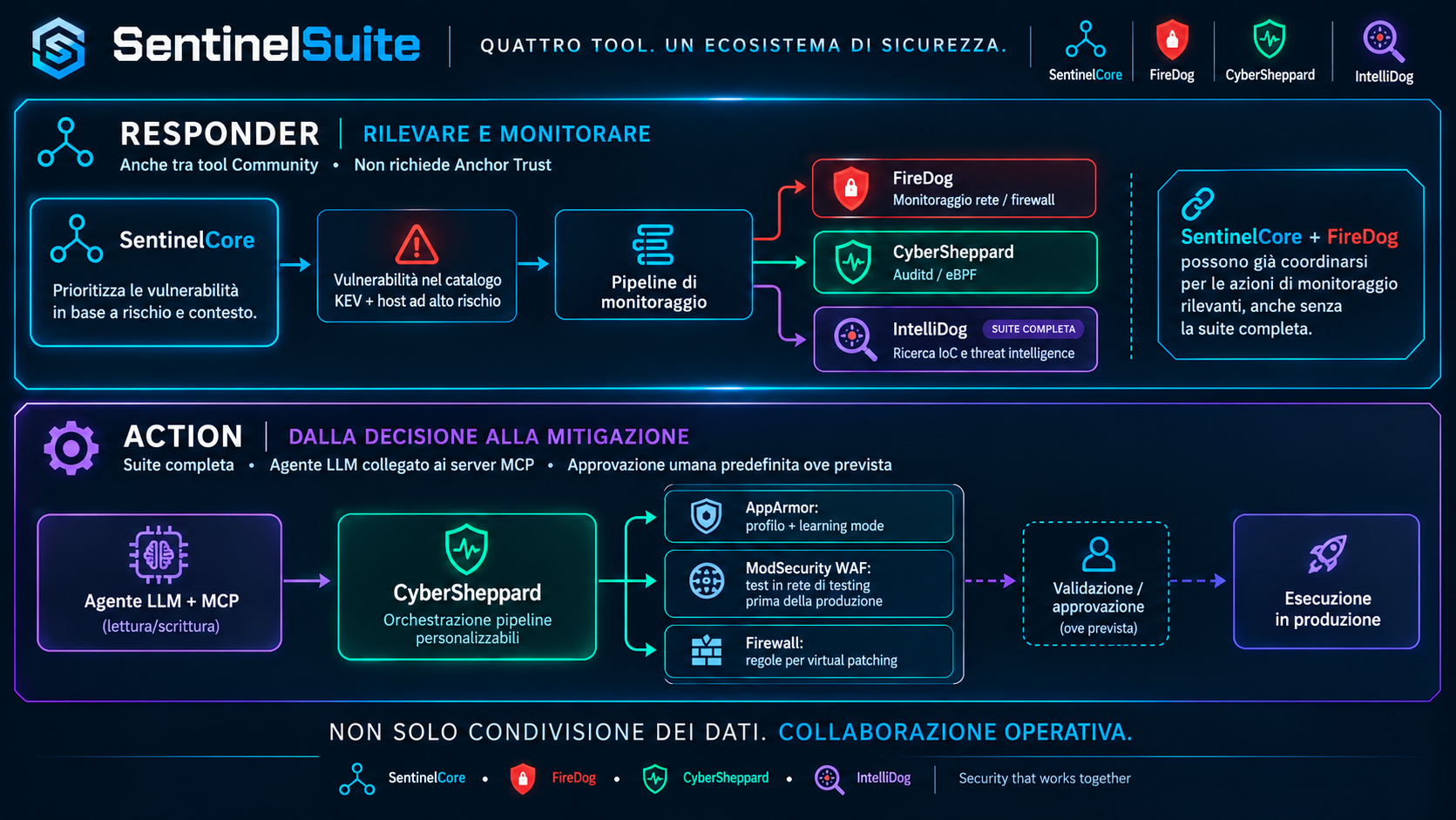
1. RESPONDER — Detect, correlate and monitor
Responder integrations manage scenarios where a security event can activate monitoring activities and other predefined responses.
They do not require CyberSheppard’s Anchor Trust and can also work between compatible community tools.
Let's imagine this scenario.
SentinelCore identifies a high-gratitude vulnerability on a high-risk host. The vulnerability is also present in the catalog Known Exploited Vulnerabilities (KEV) by CISA.
It is no longer just a vulnerability to be included in a report: it is a signal that deserves specific attention.
Depending on the available components, a security pipeline can be started involving several tools:
- SentinelCore identifies and prioritizes vulnerability on the basis of risk, context and state of known exploitation.
- FireDog can activate network activity monitoring through appropriate iptables or supported firewall rules.
- CyberSheppard can extend host-level monitoring, exploiting audited and eBPF capabilities.
- IntelliDog can contribute with the search for Compromise Indicators (IoC) and threat intelligence information, when the full suite is available.
The key point is that SentinelCore and FireDog can already collaborate for relevant monitoring actions even without the full suite and without Anchor Trust.
With CyberSheppard and IntelliDog, collaboration can extend to a more articulated pipeline, combining host monitoring, threat context and network observability.
Each tool provides its capabilities. This collaboration makes a difference.
2. ACTION — From decisions to mitigation
The Action level brings integration beyond monitoring.
It is available with the full suite and requires an LLM agent connected to the MCP servers of individual software. Each component exposes its MCP server, with read and write capabilities, to allow agents to interact with the features made available by the tools.
These integrations can orchestrate complex workflows that include changes to security configurations and countermeasures.
Some examples:
♪*] Hardening with AppArmor
Generating a security profile and starting the learning mode to help define the appropriate rules for application behavior.
♪*] Application protection with ModSecurity WAF
Generation of WAF rules, testing in the testing network and subsequent application in production after validation provided by the workflow.
♪*] Virtual patching through firewall
Creating iptables rules or other supported firewall controls to mitigate an exposure while preparing or distributing a definitive correction. We don't just talk about running a command through an AI agent. We talk about customizable pipeline, consisting of multiple steps, with execution logic, dependencies and checks defined according to the scenario. And, above all, automation must not mean loss of control.
Human approval is expected by default in the workflows that require it, unless explicit deactivation by override. In this way, each organization can define the right balance between operational speed, automation and supervision.
CyberSheppard: the orchestration center
CyberSheppard, available in the PRO version, provides an interface dedicated to the management and start of the integration pipelines. Users can customize existing workflows and build new ones, combining the features displayed by the different components of the suite. Integration is therefore not a rigid set of predefined links: it is an extensible system, which can be adapted to the infrastructure, policies and operational needs of the organization.
Thanks to the MCP servers of individual software, LLM agents can access relevant information and use the features available, respecting the permissions and controls defined in the environment.
♪*] Why is it important?
Modern security environments rarely suffer for lack of alert. The problem is to transform information into effective actions, overcoming the fragmentation of instruments, manual steps and coordination times.
The SentinelSuite approach aims to reduce this distance:
- From finding to action: Security events can activate relevant responses.
- From tools isolated to collaboration: each component contributes with its own skills.
- From rigid automation to customizable pipelines: workflows can be adapted to operational needs.
- From uncontrolled automation to governed execution: human and override approval allow you to define operational limits.
- From individual products to an ecosystem: Community and PRO capabilities can collaborate according to different integration levels.
The aim is not to replace security professionals or to grant artificial intelligence an indiscriminate control of the infrastructure.
It is to provide security teams with more effective tools to coordinate defenses, reduce manual interventions and accelerate the transition from identifying a risk to a concrete response.
With SentinelSuite, integration does not simply mean communicating the tools. It means getting them to work together.
This is the difference between connecting security products and building a coordinated defense ecosystem.
SentinelSuite — Four tools. A safer tomorrow.
ENG:
Beyond Integration: When Cybersecurity Tools Start Working Together
What if your security tools didn’t just share data, but actively collaborated to detective, monitor, and mitigate threats?
In cybersecurity, integration means often connecting APIs, aggregating logs, or correlate findings from different products.
Useful, certainly. But what if integration could go further?
♪ Dognet Technologies, we are building something different: an integration architecture in which the tools of our security suite exposes relevant data, identify opportunities for action, and proposed responses within their own areas of expertise.
Not just data correlation. Coordinated security operations.
[Sighs] Two levels of integration: Responder and Action
Our integration model is built around two categories, each designed for a different level of complexity and complexity.
1. RESPONDER — Detect, correlate, and monitor
Responder integrations handle security scenery that can trigger targeted monitoring and other pre responsedefineds without requiring CyberSheppard’s Anchor.
They can also work across Community tools.
Consider this scenario:
SentinelCore identifies at high-severity vulnerability on a high-risk host. The vulnerability is also listed in the CISA Known Exploited Vulnerabilities (KEV) Catalog. This is not just another vulnerability to add to a report. It is a signal that deserves a coordinated response.
Depending on the tools available, the integration can initiate a security pipeline involving:
- SentinelCore: identifies and prioritizes the vulnerability according to its severity, exploitation status, and the host’s risk profile.
- IntelliDog: investigates relevant Indicators of Compromise (IoCs) and threat intelligence, when available through the complete suite.
- CyberSheppard: host-level monitoring through auditd/eBPF capabilities.
- FireDog: establishes network monitoring through appropriate iptables or network-firewall rules.
The important distinction is that SentinelCore and FireDog can already collaborate on relevant monitoring actions without the complete suite or Anchor Trust. With CyberSheppard and IntelliDog, the response can extend into a broader, coordinated security pipeline. Each tool contributes its own capabilities instead of simply forwarding information to a central dashboard.
2. ACTION — From security decisions to controlled mitigation
Action integrations go further.
They are available with the complete suites and require an LLM agent connected to the software components through their respective MCP servers, with read/w capabilities. These integrations can orchestrate more complex workflows, including changes to security configurations and defensive controls.
Examples include:
- AppArmor hardening: generating a security profile and initiating learning mode to help establish appropriate application behavior.
- Web Application Firewall protection: generating ModSecurity WAF rules, testing them in a dedicated test network, and applying them to production after validation.
- Virtual patching: creating iptables or other supported firewall rules to mitigate exposure while a permanent fix is being prepared or deployed.
These are not isolated commands. They can be steps in a configurable pipeline, with dependencies, validation, and execution logic defined for the specific scenario.
And security must not become synonymous for uncontrolled automation.
Human approved is required by default for workflows that require it, unless the relevant override explicitly disables that requirement. This allows organizations to define the appropriate balance between automation, operational speed, and human control.
♪*CyberSheppard: The integration orchestrator
CyberSheppard, available in the PRO offering, provides a dedicated interface for managing and launching integration pipelines.
Users can customize existing workflows and build their own, combining the capabilities exposed by the suite’s individual components. Each component exposes its own MCP server. This gives connected LLM agents a structured way to interact with the tools, access relevant information, and execute supported operations within the permissions and controls established for the environment. The result is an architecture in which security workflows can be adapted to the organization’s infrastructure, policies, and operational requirements.
♪*♪ Why this matter
Modern security environments rarely suffer from a lack of alerts. They suffer from fragmented context, manual handoffs, and the time required to turn findings into effective defensive measures.
Our approach is designed to close that gap.
- From findings to action: security events can initiate relevant monitoring and mitigation workflows.
- From isolated tools to collaboration: each component contributionss its own specialized capabilities.
- From rigid automation to customizable pipelines: organizations can define workflows that match their operational needs.
- From arm automation to controlled execution: human approved and explicit overrides provide a configurable control boundary.
- From a single product to a security ecosystem: Community and PRO capabilities can participate at different levels of integration.
The goal is not to replace security professionals or give an AI unrestricted control over infrastructure. It is to give security teams a more effective way to coordinate their tools, veteran manual intervention, and move from identifying a risk to taking a significant defensive action.
At Dognet Technologies, integration is not about making tools talk to each other. It’s about making them work together.
That’s the difference between connecting security products and building a coordinated security ecosystem.
#Cybersecurity #SecurityAutomation #AI #MCP #ThreatIntelligence #DevSecOps #DognetTechnologies #SentinelCore #FireDog #CyberSheppard #IntelliDog #Cybersecurity #SecurityAutomation #Artificial Intelligence #MCP #ThreatIntelligence #DevSecOps

