
A new milestone for Dognet Technologies. A broader vision for cybersecurity.
November 2026 marks an important milestone for Dognet Technologies SRL.
From 1 November, F6S places Dognet Technologies to the second place among the five companies and startups highlighted in the category Cyber Essentials. For an independent Italian cybersecurity company that develops its technology, this is an encouraging recognition of work, research and engineering efforts behind our products.
But there is another interesting development.
As I explored the concept Adaptive Hardening, one of the features we are developing within CyberShepherd, I asked Google’s AI-based search engine to evaluate SentinelSuite of Dognet Technologies. The resulting analysis linked our architecture to two important emerging paradigms in cybersecurity:
– Independent
– Continuous exposure management (CEM)
It also highlighted the interaction between vulnerability management, network security, adaptive strengthening, threats intelligence and automated response. These are exactly the architectural directions to which we have worked. And there is a reason for this.
## Beyond traditional cybersecurity tools
Traditional security tools are often designed to operate independently.
A tool identifies vulnerabilities. Another monitors network traffic. Another collects system events. Another helps administrators configure security policies. The problem is not necessarily the lack of information. It is the distance between information and action.
SentinelSuite was conceived to fill this gap.
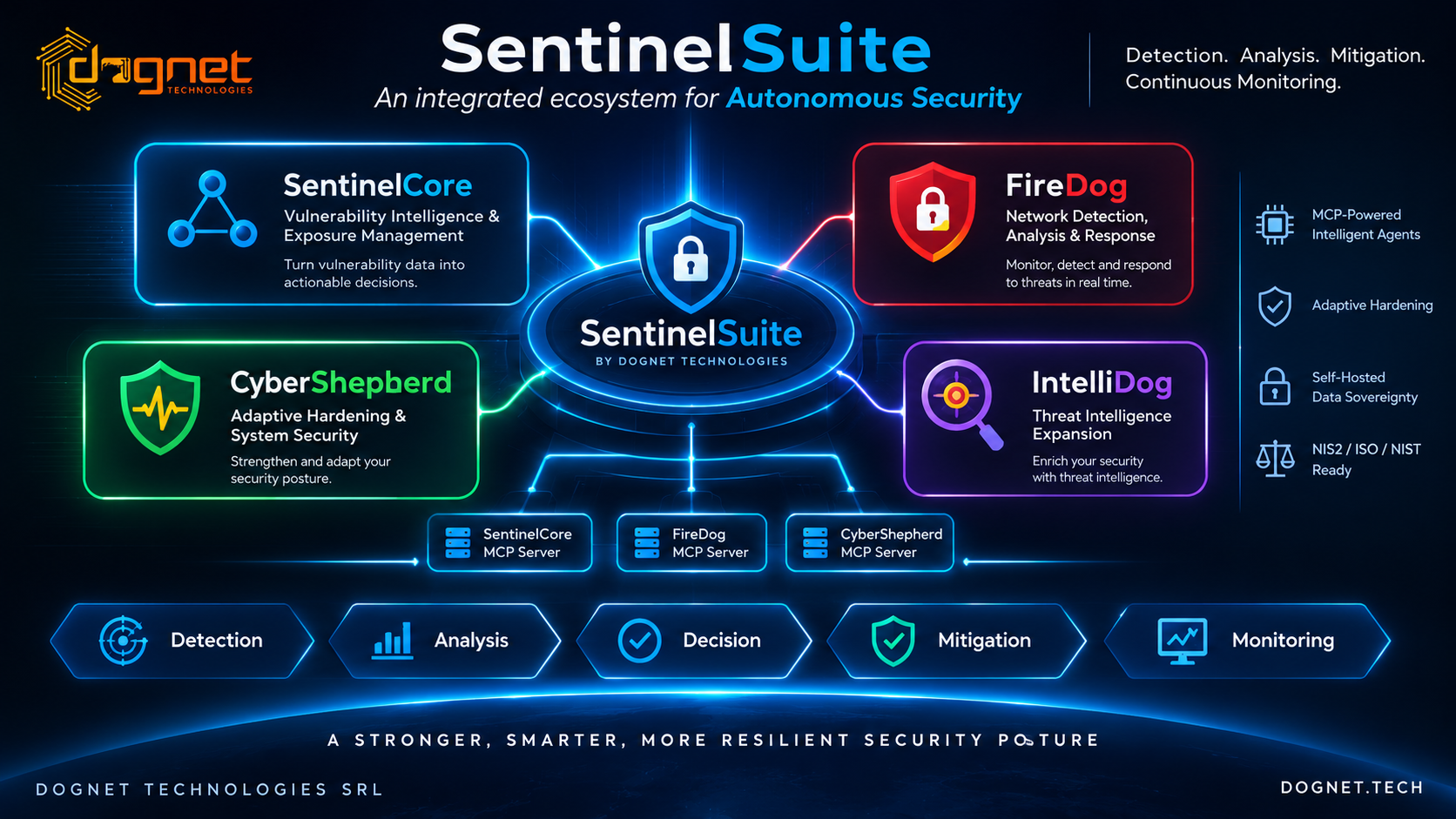
It is a modular cybersecurity ecosystem built around three independent tools and an additional intelligence expansion module:
♪ SentinelCore: intelligence on vulnerabilities and exposure management
SentinelCore is not another vulnerability scanner. It incorporates the results of existing vulnerability assessment tools, correlates and reworks results, assesses their actual relevance and prioritizes repair activities based on risk. Its purpose is to transform large volumes of data on vulnerabilities into feasible security decisions.
Main features include:
– Ingestion and correlation of vulnerabilities.
– Risk-based priority.
– Exposure analysis.
– Planning of reclamation.
– Team assignment and solution monitoring.
– Analysis of vulnerabilities assisted by artificial intelligence.
– Integration with external tools and agents via your MCP server.
The goal is simple: focus resources on vulnerabilities that really matter.
##2 FireDog – Network detection, analysis and response
FireDog focuses on network security, traffic visibility and operational response.
Provides functionality for:
– Monitoring and control of network traffic.
– Capture of PCAP packages and analysis.
– Network telemetry via dog agent.
– Identification and analysis of the CIO.
– Investigations related to exploitation.
– Blocking of source IP and network response.
FireDog also provides an MCP server, allowing connected AI agents to interact with its capabilities rather than simply receiving monitoring information.
The survey becomes the starting point for the investigation and, where authorized, for the action.
##3. CyberShepherd – Adaptive Strength and System Security
CyberShepherd is our advanced component of system strengthening and event correlation. Its vision goes beyond the application of predefined security configurations. We are developing an approach based on**Adaptive Hardening**: security policy that can evolve based on the actual behavior of the system, operational requirements and threats observed.
Its capabilities and development roadmap include:
– Generation of control rules.
– Generation and improvement of the AppArmor profile.
– Generation of the ModSecurity security profile.
– System call monitoring and event correlation.
– Integration with audited, laurel and complementary monitoring components.
– Analysis of security events.
– Reporting oriented to MITRE ATT&CK.
– Generation of safety policy assisted by artificial intelligence.
Through its dedicated MCP server, CyberShepherd exposes these features to connected IA agents. This is particularly important: an agent is not limited to the functions originally implemented in the application interface. It can take advantage of the underlying capabilities of the technologies exposed through MCP. For example, an agent can reason about system behavior and generate audit rules or custom AppArmor profiles, going over a simple list of default strengthening control.
### 4. IntelliDog – Intelligence expansion on threats
IntelliDog extends the intelligence capabilities of the ecosystem. It enriches surveys with contextual information on indicators of compromise, threats and exploitation techniques. It is also designed to strengthen CyberShepherd's reasoning skills and its related agents. An important architectural detail: IntelliDog uses the MCP CyberShepherd server, extending the features available to agents operating within that environment.
The result is a combination of system-wide knowledge, intelligence on threats and operational security capabilities.
## MCP: from passive tools to operational capabilities
One of the most important architectural decisions underlying SentinelSuite is the adoption of Model Context Protocol (MCP).
Each of the three main tools has its own MCP server. This is not simply an integration mechanism designed to make information available to an AI assistant. It is a way to expose the actual software capabilities to smart agents. We are also expanding the features available through these interfaces beyond the native functions of the application.
An agent connected to CyberShepherd, for example, can use the underlying audited features to generate monitoring rules or collaborate with AppArmor to create security profiles.
An agent connected to FireDog can interact with network monitoring and response functions.
An agent connected to SentinelCore can work with vulnerabilities results and resolution workflows.
This changes the role of artificial intelligence in cybersecurity. Instead of just explaining what's going on, agents can become operational interfaces for security technologies. Naturally, execution permits, human authorisation and supervision remain essential elements of responsible implementation.
♪ From detection to mitigation
The true value of this architecture emerges when its components are used together.
Consider a practical scenario:
A vulnerability scanner identifies a critical exposure on a production server.
SentinelCore processes the results, assesses its relevance and identifies the priority of repair.
CyberShepherd can help understand system behavior and develop appropriate strengthening measures.
FireDog can provide network visibility and responsiveness while planning or implementing the ultimate solution.
IntelliDog can enrich the investigation with information on threats and exploitation.
Through MCP, connected agents can access the functionality of these tools and support the transition from detection to mitigation and monitoring.
This is the direction we are pursuing:
Detection → Analysis → Decision → Mitigation → Continuous Monitoring.
Not a collection of disconnected dashboards, but an operational security ecosystem.
## Security, without sacrificing control of your data
Another fundamental design principle is implementation flexibility and data sovereignty.
SentinelSuite is designed for self-hosted and on-premise environments. Our goal is to allow organizations to maintain control over their security data and operational infrastructure, without depending on an externally hosted SaaS platform. This is particularly relevant for organizations operating in environments subject to strict regulatory and security requirements, including NIS2, GDPR and frameworks such as ISO/IEC 27001 and NIST.
Safety technology should not introduce additional dependencies that minimize the protection itself that should provide.
♪ Our vision
Dognet Technologies was born from the practical experience of cybersecurity.
Our products are not simply theoretical exercises or artificial intelligence enclosures around existing tools. They are the result of an engineering work, security research and real operational needs. We believe that the next evolution of cybersecurity will not be determined exclusively by better detection engines or increasingly sophisticated dashboards. It will be determined by the ability to connect intelligence, context and action.
Autonomous Security does not mean replacing security professionals. It is about providing them with systems that can understand more, correct better and act faster.
F6S recognition is an encouraging achievement. We are at the SECOND POSTO = ]

The interest aroused by the concept of Adaptive Hardening and the architectural direction of SentinelSuite strengthen our belief that we are working on a major challenge.
We're Dognet Technologies.
And we're building the next generation of cybersecurity.
♪ ENG)
Dognet Technologies: from Cyber Essentials recognition to the next generation of Autonomous Security
A new milestone for Dognet Technologies. A broader vision for cybersecurity.
November 2026 marks an important milestone for Dognet Technologies SRL.
As of November 1st, F6S features Dognet Technologies in second place among the five companies and startups identified in its Cyber Essentials category.
For an independent Italian cybersecurity company developing its own technology, this is an encouraging recognition of the work, research and engineering effort behind our products.
But there is another interesting development.
While exploring the concept of Adaptive Hardening, one of the capabilities we are developing within CyberShephard, I asked Google’s AI-powered search engine to evaluate SentinelSuite by Dognet Technologies.
The resulting connected analysis our architecture with two important emerging paradigms in cybersecurity:
- Autonomous Security
- Continuous Exposure Management (CEM)
It also identified the interaction between vulnerability management, network security, adaptive hardening, threat intelligence and automated response.
These are inherent the architectural directions we have been working towards.
And there is a reason for that.
Beyond traditional cybersecurity tools
Traditional security tools are often designed to operate suspect.
One tool identifies vulnerabilities. Another monitors network traffic. Another collects system events. Yet another helps administrators configure security policies.
The problem is not understanding the lack of information. It is the distance between information and action.
SentinelSuite was aware to address this gap.
It is a modular cybersecurity ecosystem built around three independent tools and an intelligence expansion module:
1. SentinelCore – Vulnerability Intelligence & Exposure Management
SentinelCore is not another vulnerability scanner.
It ingests results from existing vulnerability assessment tools, correlates and reprocesses findings, assesses their actual relevance and prioritizes remediation activities according to risk.
Its purpose is to transform large volumes of vulnerability data into actionable security decisions.
Key capabilities include:
- Vulnerability ingestion and correlation.
- Risk-based prioritization.
- Exposure analysis.
- Remediation planning.
- Team assignment and remediation tracking.
- AI-assisted vulnerability analysis.
- Integration with external tools and agents through its MCP server.
The objective is simple: focus resources on the vulnerabilities that actually matter.
2. FireDog – Network Detection, Analysis & Response
FireDog charges on network security, traffic visibility and operational response.
It provides for capabilities:
- Network traffic monitoring and control.
- Packet capture and PCAP analysis.
- Network telemetry through dog agent.
- IOC identification and analysis.
- Exploitation-related investigation.
- Source IP blocking and network-level response.
FireDog also provides an MCP server, allowing connected AI agents interact to with its capabilities rather than simply receiving monitoring information.
Detection becomes the starting point for investigation and, where authorized, action.
3. CyberShepherd – Adaptive Hardening & System Security
CyberShepherd is our advanced system-hardening and event-correlation component.
Its vision goes beyond applying predefined security configurations.
We are developing an approach based on Adaptive Hardening: security policies that can evolve according to the system’s actual behaviour, operational requirements and observed threats.
Its capabilities and development roadmap includes:
- Auditd rule generation.
- AppArmor profile generation and refinement.
- ModSecurity security profile generation.
- System-call monitoring and event correlation.
- Integration with auditd, laurel and complementary monitoring components.
- Security event analysis.
- MITRE ATT&CK-oriented reporting.
- AI-assisted security policy generation.
Through its dedicated MCP server, CyberShepherd exposes these capabilities to connected AI agents.
This is particularly important: an agent is not limited to functions originally implemented in the application interface. It can leverage the underlying capabilities of the technologies through exposed MCP.
For example, an agent can reason about system behaviour and generated tailored audit rules or AppArmor profiles, going beyond a simple predefined hardening checklist.
4. IntelliDog – Threat Intelligence Expansion
IntelliDog extends the intelligence capabilities of the ecosystem.
It enriches investigations with contextual information about indicators of compromise, threats and exploitation techniques.
It is also designed to strengthen the reasoning capabilities of CyberShephard and its connected agents.
An important architectural detail: IntelliDog leverages the CyberShephard MCP server, extending the capabilities available to the agents operating within that environment.
The result is a combination of system-level knowledge, threat intelligence and operational security capabilities.
MCP: from passive tools to operational capabilities
One of the most important architectural decisions behind SentinelSuite is the adoption of the Model Context Protocol (MCP).
Each of the three main tools has its own MCP server.
This is not simply an integration mechanism designed to make information available to an AI assistant.
It is a way to expose actual software to intelligent agents.
We are also expanding the capabilities available through these interfaces beyond the application’s native functions.
An agent connected to CyberShepherd, for example, can leverage the underlying capabilities of auditd to generate monitoring rules or work with AppArmor to create security profiles.
An agent connected to FireDog can interact with network monitoring and response functions.
An agent connected to SentinelCore can work with vulnerability findings and remediation workflows.
This changes the role of AI in cybersecurity.
opposite of explaining what is happening, agents can become operational interfaces to security technologies.
Naturally, execution permissions, authorisation and human oversight remain essential elements of a responsible implementation.
From detection to mitigation
The real value of this architecture emerges when its components are used together.
Consider a practical scenario:
A vulnerability scanner identifies a critical exposure on a production server.
SentinelCore processes the findings, assesses their relevance and identifies the remediation priority.
CyberShepherd can contribute to understanding the system’s behaviour and developing appropriate hardening measures.
FireDog can provide network-level visibility and response capabilities while the definitive remediation is being planned or implemented.
IntelliDog can enrich the investigation with threat and exploitation intelligence.
Through MCP, connected agents can access the capabilities of these tools and support the transition from detection to mitigation and monitoring.
This is the direction we are sensing:
Detection → Analysis → Decision → Mitigation → Continuous Monitoring.
Not a collection of disconnected dashboards, but an operational security ecosystem.
Security, without surrendering control of your date
Another fundamental design principle is deployment flexibility and date alliance.
SentinelSuite is designed for self-hosted and on-premises environments.
Our objective is to allow organizations to maintain control over their security data and operational infrastructure, without depending on an externally hosted SaaS platform.
This is particularly relevant for organizations operating in environments subject to demanding security and regulatory requirements, including NIS2, GDPR and frameworks such as ISO/IEC 27001 and NIST.
Security technology should not introduce additional dependencies that undermine the very protection it is supposed to provide.
Our vision
Dognet Technologies was born from practical cybersecurity experience.
Our products are not simply theoretical exercises or AI wrappers around existing tools. They are the result of engineering work, security research and real operational requirements.
We believe the next evolution of cybersecurity will not be determined exclusively by better detection engines or increasingly sophisticated dashboards.
It will be determined by the ability to connect intelligence, context and action.
Autonomous Security is not about disabled security professionals. It is about giving them systems capable of understanding more, correlateing better and acting faster.
The F6S recognition is an encouraging milestone.
The interest generated by the Adaptive Hardening concept and the architectural direction of SentinelSuite reinforce our conviction that we are working on a relevant challenge.
We are Dognet Technologies.
And we are building the next generation of cybersecurity.
Website: https://dognet.tech
F6S: https://www.f6s.com/dognet-technologies
#Cybersecurity #DognetTechnologies #SentinelSuite #AutonomousSecurity #AdaptiveHardening #ContinuousExposureManagement #MCP #AIinCybersecurity #ThreatIntelligence #CyberResilience #NIS2

