
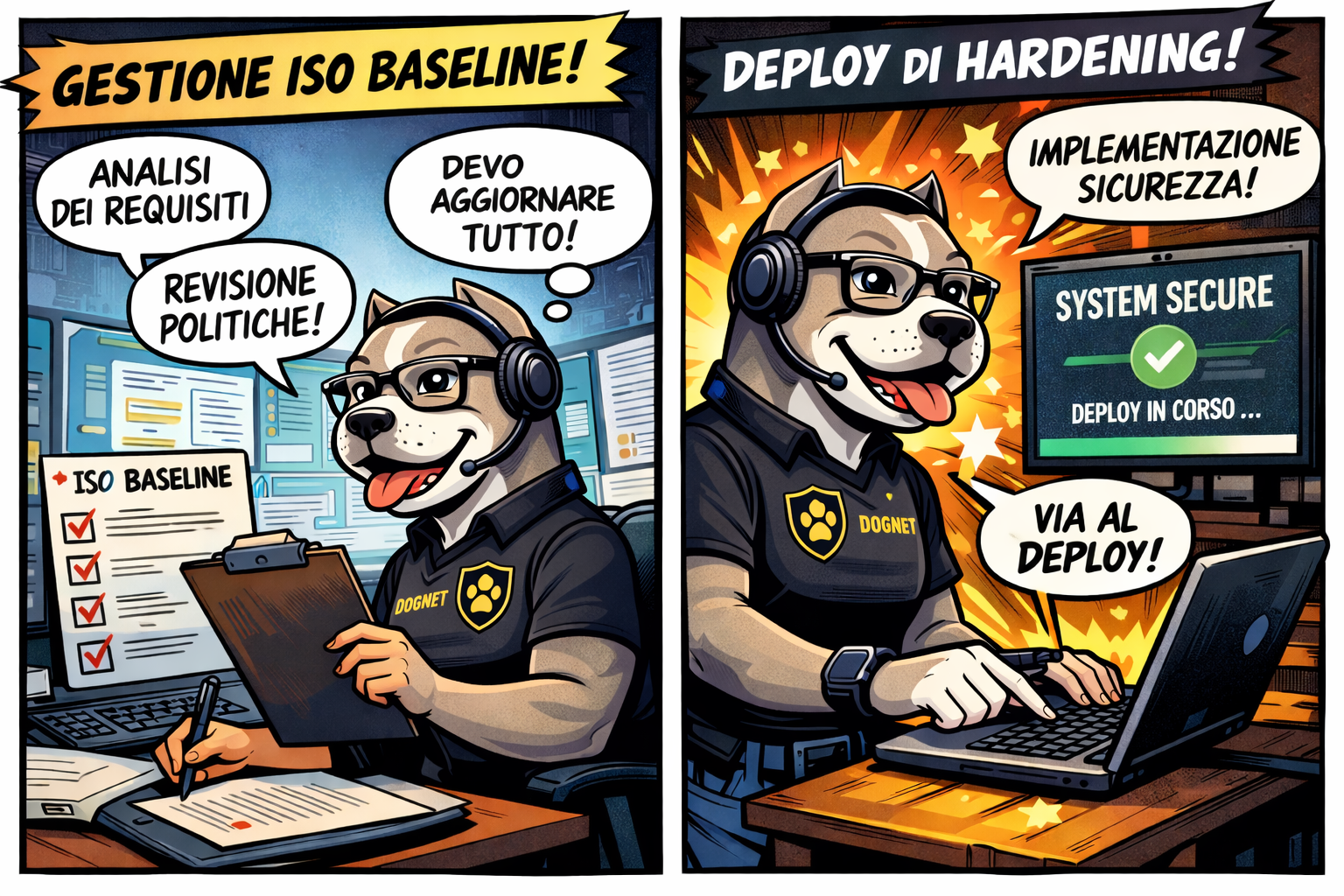
IT infrastructure security management today requires a systematic approach that goes beyond manual configurations and spot interventions. For DevOps and Project Manager teams dealing with compliance and hardening, pre-configured ISO baseline integrated with version control systems is a paradigm shift in safety posture management.
The UnStandardized Configuration Problem
According to CIS (Center for Internet Security), 80% of successfully exploited vulnerabilities come from misconfigurations rather than from zero-day exploit. Organizations are often managed:
- Unconsistent configurations between different environments (dev, staging, production)
- No traceability of security changes
- High deployment times for new compliant instances
- Difficulty in rollback of problematic configurations
- Lack of visibility on the hardening status in real time
Manual creation of each system according to standards such as ISO 27001, CIS Benchmarks or industry-specific regulations involves not only a significant operational overhead, but also a high risk of human error.
Baseline ISO as Security Posture Foundation
One hardened ISO baseline is an image of the pre-configured operating system according to consolidated security best practices. For Linux environments – especially Debian and derived distributions – an effective baseline includes:
- Hardening kernel: optimized sysctl parameters, disabling unnecessary modules
- User management and privileges: implementation of the principle of minimum privilege, PAM configuration, robust password policy
- Minimal services: removal of non-essential software, disabling unnecessary services
- Network security: firewall configuration (iptables/nftables), disabling outdated protocols
- Logging and auditing: auditd configuration for compliance and forensics
- File system security: correct permissions, use of secure mount options (noexec, nosuid)
The main advantage is that each new instance already starts from a secure and conform state, drastically reducing the initial attack surface.
Git as Single Source of Truth for Hardening
The integration of the baseline with Git introduces the principles ofInfrastructure as Code (IaC) in managing security compliance:
Version Control for Configurations
Each change to hardening configurations is traced through commit Git, providing:
- Complete audit trail: who changed what, when and why
- Peer review: possibility of implementing workflow approval (pull request) before application
- deterministic rollback: ability to return to previous known and working configurations
- Branching strategy: parallel development of configurations for different environments or compliance requirements
Baseline Evolutionary Management
Organizations must face ever-changing security requirements. Through Git it is possible:
- Create branch for different baselines: production-hardened, development-baseline, pci-dss-compliant
- Apply incremental security patches: Merge of updated configurations
- Testing changes in insulation: feature branch for new policies before merge
- Documenting decisions: clients detailed message explaining the rationale of configurations
This approach allows to treat security configuration as an application code, with the same quality and governance standards.
Enterprise Automation: Integration with Ansible
For enterprise organizations with complex infrastructure, integration with Ansible allows:
- Orchestrate large-scale deployment: consistent application of baselines on hundreds of hosts
- Implement configuration drift remediation: automatic detection and correction of deviations from the baseline
- Manage idempotent configurations: guarantee that the repeated application produces the same result
- Integrate with CI/CD pipeline: Automated configuration testing before deployment
The combination Git + Ansible + Baseline ISO creates a GitOps workflow for security, where the desired state of the infrastructure is defined in repository and automatically reconciled.
Continuous monitoring: The Role of Baseline Manager
The creation of the baseline is only the beginning. The real challenge is to maintain compliance over time, facing:
- Configuration drift: unauthorized manual changes
- Degradation of safety posture: accumulation of minor deviations
- Need for adaptation: controlled introduction of justified exceptions
A Baseline Manager integrated into modern SIEM platforms offers:
Real Time Monitoring
Continuous detection of hardening status with immediate alerting on critical deviations from the reference baseline.
Historical and Differences
Maintaining the complete historical configurations with display of "diffs" between successive states, essential for:
- Audit and compliance reporting
- Root causes analysis of accidents
- Evaluation of the impact of changes
Life Cycle Management
Integration with the Git repository for:
- Real-time comparison between deployed status and been declared in the repository
- Ease of rollback to previous versions tested
- Support for the introduction of incremental changes with validation
Best Practice for Implementation
1. Principle of the Least Privilege
Each baseline should implement the minimum set of necessary permits, with controlled extension possibilities.
2. Customizable
Baselines must be customizable templates, not rigid standard one-size-fits-all. Document each deviation from the standard baseline.
3. Rigorous Testing
Implement test environment where to validate new baselines or changes before deployment in production.
4. Documentation As Code
Keep README.md and documentation/ in the Git repository along with configurations, explaining the implementation choices.
5. Compliance as Code
Integrate policy-as-code tool (Open Policy Agent, InSpec) for automatic compliance validation before deployment.
Conclusion: Security by Design, Operationally Sustainable
Adoption of hardened ISO baseline managed by Git represents a natural evolution towards a security posture modern:
- Reproducible: each deployment starts from the same safe state
- Traceable: each change is documented and reversible
- Automated: reduction of manual intervention and error risk
- Auditable: demonstrable compliance through complete historical
- Scale: Applicable from single servers to complex cloud infrastructure
For organizations facing stringent compliance requirements (ISO 27001, PCI-DSS, GDPR) or managing critical infrastructure, this approach is no longer an "nice to have" but a operational need.
Dognet Technologies srl offers consulting services for the creation of customized baseline and automated deployment, with the new Baseline Manager integrated into the platform Cybersheppard – MicroSIEM for continuous monitoring and management of hardening status.
Cybersecurity can no longer be an episodic activity: it must be continuous, versioned and verifiable. The ISO baseline managed with Git is the foundation on which to build this new operation.
#CyberSecurity #DevSecOps #Compliance #InfrastructureAsCode #Hardening #ISO27001 #GitOps #SecurityBaseline #SIEM

